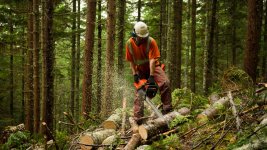
Many jobs have beenreshaped by AI, but it's unlikely that AI agents will be putting out house fires or trimming your trees anytime soon.
Firefighting, after all, requires skills like stamina, strength, "danger detection" and spatial awareness, making it the No. 1 job in a July 10listof "AI-proof" roles that rely on uniquely human abilities from Resume Now, an online resume builder and career platform.
To come up with its rankings, Resume Now analyzed data from the U.S. Department of Labor's Occupational Information Network (O*NET), focusing on six key abilities: stamina, static strength, reaction time, spatial orientation, time sharing and problem sensitivity.
Amid concerns aboutAI's impact on the job market, many workers are looking to careers they see as less exposed to AI, which has contributed to a growing interest inskilled tradesandblue-collar jobs. Sixty-two precent of professionals said they would choose a blue-collar role if it promised better pay and stability than their current occupation, according to an August 2025 FlexJobs survey.
These jobs aren't necessarily AI-proof "simply because they involve physical labor," but also because each role requires a high level ofhuman judgmentand oversight, according to to Resume Now career expert Keith Spencer. Workers in these roles "have to be able to recognize problems, interpret changing conditions and make decisions" in unpredictable environments, he tells CNBC Make It.
Many of these jobs also involve "a level of danger to yourself or others," Spencer says, so workers must be prepared to "react in real time" when something goes wrong and take accountability for the outcome. In a life-or-death scenario, he says, "you don't necessarily want an AI agent making that final call."
According to Resume Now, these are the top 10 occupations that rely most heavily on human judgment and skill, as well as each role's median annual wage, based on data from the U.S. Bureau of Labor Statistics, and the key abilities it requires, based on O*NET data.
Key abilities:Strength, stamina, reflexes, spatial awareness and danger detection in emergency settings
2. Airline pilots, copilots and flight engineers
Key abilities:Reflexes, navigation, multitasking and risk detection during flight
3. Manufactured building and mobile home installers
Key abilities:Strength, stamina, reaction time and problem sensitivity on variable job sites
Key abilities:Strength, reflexes, stamina and hazard awareness in outdoor work
5. Structural iron and steel workers
Key abilities:Strength, endurance, coordination and danger detection in construction settings
6. Derrick operators, oil and gas
Key abilities:Strength, alertness and safety awareness around heavy equipment
Key abilities:Strength, reaction time, spatial awareness and danger detection underground
Key abilities:Navigation, reflexes, multitasking and early problem detection
Key abilities:Spatial orientation, strength, stamina and judgment in changing outdoor conditions
Key abilities:Reflexes, strength, stamina and hazard detection in high-risk logging work
Considering the risks and physical labor involved, these jobs aren't for everyone, Spencer says. But he says workers in all fields can benefit from sharpening otherAI-proof skillslike versatility, creativity and critical thinking.
According to Spencer, workers should ask themselves, "What are theuniquely human skillsthat are most likely to be valued in the future?" and "How can I continue honing those skills throughout my career while also learning how to use AI in meaningful ways?"
Since few people have entirelylinear career trajectories, he says, it can also be helpful to ask yourself, "How can I leverage those skills and abilities in other paths that I want to pursue?"
Particularly in the AI era, skills like adaptability, judgment andproblem-solvingare "key to future success," Spencer says: "Regardless of the environment and the type of work that you want to be doing, those types of skills are going to continue being valuable."
Want to get ahead at work? Then you need to learn how to make effective small talk.In CNBC's new online course,How To Talk To People At Work, expert instructors share practical strategies to help you use everyday conversations to gain visibility, build meaningful relationships and accelerate your career growth. Sign up today!
Take control of your money with CNBC Select
CNBC Select is editorially independent and may earn a commission from affiliate partners on links.
Get Make It newsletters delivered to your inbox
Learn more about the world of CNBC Make It


