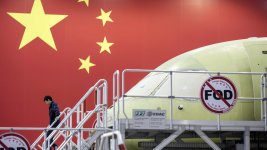
China's homegrown C919 passenger jet departed on its first scheduled international commercial flight Wednesday, marking a milestone in Beijing's push to develop an alternative toBoeingandAirbus.
The Air China-operated jet took off from Beijing Capital International Airport bound for Ulaanbaatar, Mongolia, just after 3:00 p.m. local time (3:00 a.m. ET), according to FlightRadar24. It marks the first time the narrow-body aircraft has operated beyond Chinese territory.
The Beijing-Ulaanbaatar service is set to operate daily, according to Air China.
The flight marks another step in China's effort to establish the state-owned Commercial Aircraft Corporation of China, or COMAC, as a competitor in a global passenger aircraft market dominated by U.S.-based Boeing and Europe's Airbus.
However, the C919 is still reliant on foreign components and has not received certification from major U.S. or European aviation regulators, limiting its ability to win customers in many overseas markets.
Nevertheless, COMAC has increasingly showcased the aircraft overseas. The C919 and smaller C909 made their Dubai Airshow debuts in November 2025, whereCOMAC said it wanted to deepen tieswith the global aviation industry.
The C919 is a single-aisle narrow-body airliner that can carry up to 174 passengers, designed for the same broad market segment as Boeing's 737 MAX and Airbus's A320neo.
Can COMAC challenge Boeing and Airbus?
While China is one of the world's largest aviation markets, giving COMAC a meaningful domestic customer base, the country's domestic airlines continue to depend on Boeing and Airbus aircraft.
In May, China confirmed anorder of 200 Boeing planes, as well as engines and spare parts, demonstrating the country's continued reliance on U.S.-made commercial jets even as Beijing backs COMAC.
COMAC has built up a substantial order backlog, mainly from Chinese airlines and leasing companies. However, it delivered only 15 C919 aircraft last year, well below the 75 it had targeted,according to Air Data News.
While production ramped up towards the end of the year, output is still dwarfed by that of Airbus and Boeing.
Aircraft production is both complex and vulnerable to supply chain disruptions, with shortages of even relatively minor components capable of preventing a finished jet from being delivered.
Rob Morris, a now-retired aviation analyst, told CNBC via email that "COMAC's pace of development and production is simply too slow" to genuinely compete with Airbus and Boeing.
He added: "Whilst the C919 does have potential to impact Airbus and Boeing sales in China…the slow pace of execution means it will take time. I think the reason for this is passenger and airline acceptance."
"It is not just enough to develop, build and deliver the aircraft, the OEM has to provide 24/7/365 in service support to ensure dispatch reliability of the C919 matches those of the well understood and established A320 and 737. This takes time and is only proven by sustained operation."
"How many parts does it take to build a plane? The answer is all of them," Richard Aboulafia, managing director at AeroDynamic Advisory, told CNBC earlier this year. "Even if it's just fasteners, it means you can't build the plane."
The complexity means bottlenecks can emerge several layers down the supply chain, Aboulafia said, with shortages ranging from engines and fuselage components to castings, forgings and fasteners.
- CNBC's Evelyn Cheng contributed to this report.


