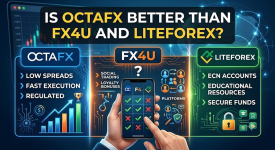
Finding a forex broker has never been easier. Choosing the right one is a different story.
Spend just a few minutes browsing trading forums, Facebook groups, Reddit discussions, or YouTube reviews, and you'll quickly notice the same broker names appearing again and again. OctaFX, FX4U, and LiteFinance are among the platforms that retail traders frequently compare, especially across Asia, where all three have built a recognizable presence over the years.
On paper, the differences don't seem dramatic. Each broker provides access to the MetaTrader platform, supports leveraged CFD trading, offers a wide selection of currency pairs, and promises competitive spreads alongside fast deposits and withdrawals. If you only compare the numbers shown on their homepages, it's easy to assume that choosing between them is simply a matter of personal preference.
The reality is usually more complicated.
A broker isn't judged by its marketing pages. It earns its reputation once you begin trading with real money. Execution quality during volatile market conditions, pricing consistency, platform stability, order processing, withdrawal experience, and customer support all become far more important than an attractive promotional campaign or a headline spread that looks impressive at first glance.
This is exactly where many comparison articles fall short. Most of them repeat the same specifications that brokers publish on their websites, place everything into a comparison table, and end with a generic recommendation. While that approach may provide a quick overview, it rarely answers the questions traders actually care about before opening an account.
Can a broker maintain stable execution during major economic news releases? Does the trading environment remain consistent when market volatility increases? Are low spreads still competitive after commissions and swap charges are taken into account? Which platform feels more reliable for day trading? Which broker is better suited to beginners, and which one offers a stronger overall experience for more active traders?
Those are the questions that matter, and they deserve more than a simple yes-or-no answer.
This guide takes a practical approach by comparing OctaFX, FX4U, and LiteFinance across the areas that have the greatest impact on everyday trading. Rather than focusing only on promotional features, we'll examine the overall trading experience, the cost of trading, platform performance, account flexibility, available markets, deposit and withdrawal processes, educational resources, customer service, and the type of trader each broker is best suited for.
It's also important to recognize that there is no universal "best broker." A trader who mainly holds positions for several days may value reliability and low overnight costs, while a scalper opening dozens of positions during a single session is likely to care much more about execution speed and spread consistency. Someone interested in copy trading may prioritize social trading features, whereas another trader may only need a straightforward MetaTrader account with competitive pricing.
Understanding those differences is often more valuable than comparing a few technical specifications.
By the end of this comparison, you'll have a much clearer picture of how OctaFX performs against FX4U and LiteFinance, where each broker stands out, where compromises may exist, and which one is most likely to fit your own trading style rather than someone else's.
Why Are Traders Comparing These Three Brokers?
Retail traders rarely compare brokers at random. In most cases, OctaFX, FX4U, and LiteFinance appear together because they target a similar audience. They all focus on providing accessible CFD trading through the MetaTrader ecosystem while offering relatively low barriers to entry. For traders in Southeast Asia and many emerging markets, these brokers are often among the first names encountered when searching for a new trading account.
Despite those similarities, each broker has developed a different identity over time.
OctaFX has built its reputation around simplicity. The registration process is straightforward, the trading environment is designed to be beginner-friendly, and the broker has invested heavily in educational content and copy trading. For someone opening a first trading account, OctaFX can feel approachable without requiring extensive market experience.
FX4U follows a different path. Instead of trying to become a global household name overnight, it has concentrated on serving specific regional markets. Its appeal often comes from localized payment methods, language support, and trading conditions tailored to the needs of its primary customer base. For many traders, convenience rather than brand recognition becomes the deciding factor.
LiteFinance, formerly known as LiteForex, approaches the market from another angle. With a longer operating history than many newer competitors, it has gradually expanded beyond basic forex trading into a broader trading ecosystem that includes ECN-style accounts, social trading features, research tools, and educational resources. That broader offering has helped it remain relevant as trader expectations have evolved.
Because these brokers occupy a similar part of the retail trading market, comparisons between them are inevitable. The challenge isn't identifying which broker offers the longest list of features. It's determining which one delivers the most suitable experience for the way you actually trade.


